
Golden Times: When Privileges Shaped Destiny
When one thinks of historical nobility today, images of grand balls, sparkling chandeliers, and elegant carriages often come to mind. Yet behind this dazzling facade lay a ruthless system that divided society into two vastly unequal halves for centuries. On one side stood the overwhelming majority of the population, toiling in the fields, paying taxes, and possessing few rights. On the other side reigned a vanishingly small upper class, for whom life was an almost endless procession of exclusive special rights.
The word privilege derives from Latin, meaning an exception to the law, and that is precisely what it was in the truest sense. Those born into noble families entered the world on a red carpet, which cleared almost every stumbling block from their path. One did not have to toil to earn one’s social standing, take examinations, or engage in negotiations. The mere cradle in which one lay determined power, wealth, and prestige.
These privileges were by no means mere folkloric embellishments; they formed the legal and economic foundation of entire states. A noble not only owned lands but often dictated the fate of the people living on them. They collected tithes and dues while remaining exempt from most burdens of the community. The rules that applied to ordinary citizens were etched in stone, only to cease at the gates of the castle grounds.
It was a world of absolute self-evidence, where inequality was celebrated not as a scandal but as a divinely ordained order. From today’s perspective, this rigid structure seems almost absurd, yet it shaped generations’ understanding of what prestige and social stature entailed. To grasp why noble titles still possess such a fascinating aura today, it is worth examining how this power manifested in everyday life back then.
Hunting, Taxes, and a Private Judge: The Three Pillars of Power
When considering daily life in the Middle Ages and the Early Modern Period, noble privileges rested primarily on three unshakeable pillars that were simply denied to the rest of the population. The first and most visible in the landscape was the exclusive right to hunt. Forests, meadows, and rivers were regarded as the private playground of the lord of the castle. While a peasant whose crops were trampled by hungry wild boars was not even allowed to aim a slingshot at the animals, the noble society rode across the fields in colourful garments with packs of hounds. Anyone from the common folk who caught even a single rabbit to feed their starving children would find themselves hanged as a poacher or imprisoned in the deepest dungeon.
The second pillar was a dream that modern citizens can only envy: the extensive exemption from taxes. According to the logic of the time, the nobility did not pay their dues in mere gold but with their own blood on the battlefield. Even when the age of knights had long passed and mercenary armies fought the wars, princes and barons simply retained this tax exemption. The common people bore the entire burden of the state, financing magnificent roads, fortifications, and bridges, while the lords resided in their castles without having to contribute a penny to the public treasury.
The third and perhaps most unsettling pillar concerned the judiciary. Should a noble ever find themselves in conflict with the law, they had no reason to fear being dragged before the same judge as the blacksmith or the miller. The nobility was subject to what was known as patrimonial jurisdiction or their own court systems. This meant that one was judged exclusively by peers, who naturally had a very pronounced understanding of the missteps of their own caste. Moreover, the landowner often acted as the highest judge over their subjects on their own lands, making justice a rather one-sided affair.
These three pillars secured the upper class a wealth of power that seems unimaginable today. They demonstrated daily who held the strings and who had to bend to the will of the rulers. It was an era where law did not protect against arbitrariness but, on the contrary, cemented inequality with legal precision.
Ceremony and Splendor: The Fine Privileges at Court
In addition to the tangible legal and financial power, there existed a world of subtle status symbols that was equally strict. At the princely court, no step, no glance, and no breath was left to chance. Who could stand where, how deeply one had to bow before whom, and who passed the dish to whom at the table were meticulously regulated in ceremonial books. This court protocol acted like an invisible hierarchy, which made it abundantly clear to everyone present exactly where their place in the universe was.
This separation was particularly stark in the so-called dress codes. Today, anyone wears what they like and what their wallet allows. In the past, however, real trouble awaited a wealthy merchant who dared to don velvet, ermine, or expensive silk. Such precious fabrics were legally reserved exclusively for the high nobility. Even certain colours, such as the exalted purple, or the wearing of gold jewellery were strictly regulated. The message was clear: No one should adorn themselves with borrowed plumes or even give the impression of belonging to the chosen elite.
Even in public spaces, the nobility demanded their rightful precedence. At ceremonial processions, in church, or later in the opera, the front rows, the most splendid boxes, and the most comfortable velvet seats naturally belonged to counts and barons. An ordinary citizen had to step aside, remove their hat, and bow their head when a noble carriage rattled over the cobblestones. Even in death, the differentiation continued: private chapel and richly adorned family tombs ensured that one would not spend eternity alongside the common folk after taking their last breath.
These fine privileges created an aura of unattainability. They transformed the nobles into figures who seemed to float above earthly matters. They staged themselves as if on a theatre stage, and the audience was expected to marvel and applaud accordingly.
The Sudden End: When Special Rights Fell
As unshakeable as this splendid fortress of privileges and splendor seemed for centuries, it ultimately collapsed with surprising speed. When the last German Emperor abdicated in November 1918 after the upheavals of the First World War, the foundation of the old order had already become fragile. The final legal punctuation was set by the Weimar Constitution in August 1919 with its famous Article 109. With a single sentence, the newly elected legislature wiped all public legal privileges of birth off the table without replacement.
Overnight, the three great pillars of noble supremacy evaporated into thin air. The hunting of deer and wild boar was henceforth bound to ordinary lease agreements and clear laws, rather than being an exclusive birthright of the lord of the castle. Tax offices no longer turned back at noble portals but demanded taxes and dues like from any other citizen. And those who found themselves in conflict with the law now faced entirely ordinary state judges, regardless of how many dukes populated their family tree.
Court protocol also vanished from official offices. Authorities were instructed to no longer make deferential bows and to refrain from using submissive titles such as Highness or Illustrious in official correspondence. For many members of the old upper class, this change felt like a harsh fall. They suddenly had to learn to queue in forms just like the baker or the postman.
However, the republic did not prohibit people from maintaining their identity. While legal special statuses were abolished, the resonant titles were retained as a simple part of the civil surname. Power was forever broken, and the privilege of birth became history. What surprisingly survived, however, was the fascination for the extraordinary, which would develop in an entirely new direction in the decades to come.
The Modern Upgrade: Attention, Charm, and the Little Red Carpet
Those who believe that the allure of a noble title has vanished with the end of the old laws underestimate human psychology significantly. People love stories, glamour, and the extraordinary. While there are no longer tax exemptions or subjects in the twenty-first century, there exists a brand new, immensely pleasant privilege that can be casually embraced today: pure, unadulterated attention in everyday life.
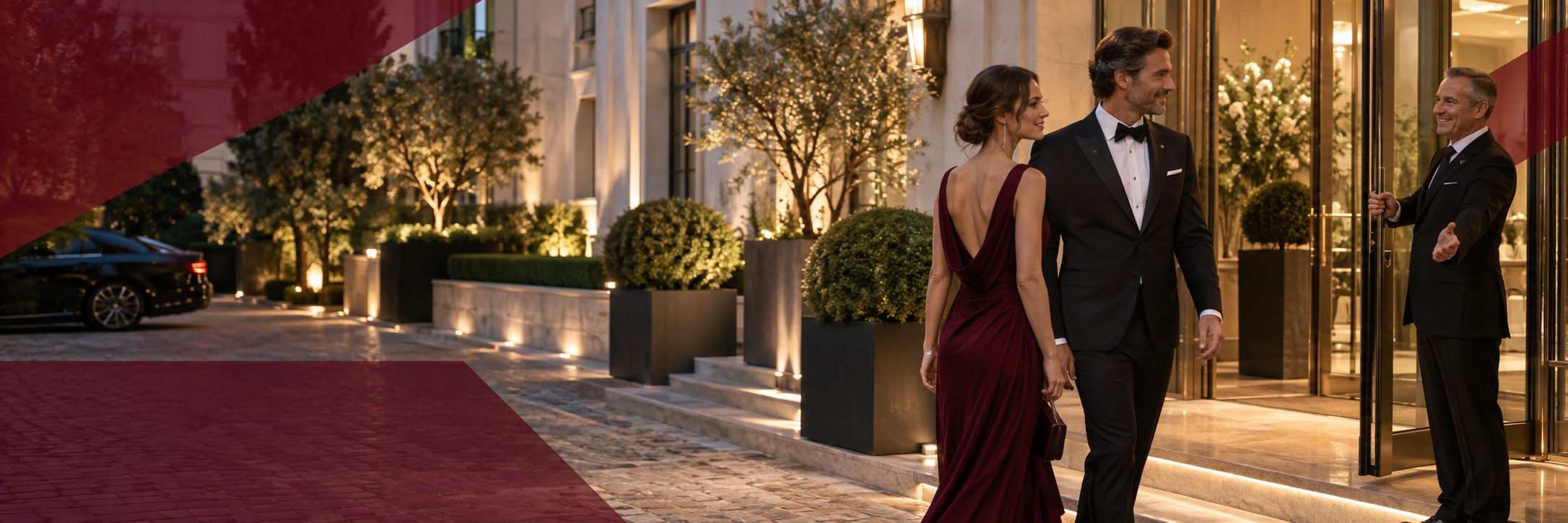
Everyone knows the phenomenon that in a hectic, digitized world, many encounters sink into a homogeneous blur. Yet as soon as a resonant name comes into play, the atmosphere noticeably shifts. When one reserves a table at a first-class restaurant under the name Count or Baron, they almost always notice a welcoming smile upon arrival. The sommelier instinctively takes a moment longer to recommend the perfect wine, and at the hotel, a standard room may, with a bit of luck, casually transform into a suite overlooking the park.
This is not due to some otherworldly subservience but simply the joy of playing with style and elegance. People appreciate a charming demeanor, and a well-sounding title acts as an elegant icebreaker. At private invitations, business receptions, or on fine stationery, it immediately provides conversation material, arouses curiosity, and elevates its bearer in a refreshingly unobtrusive way above the crowd.
Modern privileges are no longer hard legal rights but soft, social advantages. It is the privilege of being remembered, standing out positively, and bringing a touch of historical grandeur into everyday life for oneself and others. No one has to perform servitude anymore, but a smile and a hint of a red carpet are almost guaranteed everywhere.
Nobility as an Attitude: The Most Beautiful Privilege of Our Time
When one considers the historical development from medieval class privileges to the present day, a remarkable transformation emerges. In the past, a noble title was a rigid straitjacket that came with hard political power, strict social isolation, and often great responsibility towards dynasty and court. One was born into a fate that allowed little room for personal freedom.
Today, however, true nobility is completely free from these constraints. No one has to fight battles, manage feudal estates, or justify themselves before noble judges anymore. What remains is the essence of it all: a commitment to elegance, good taste, and sovereign calm. Those who choose a resonant title today do not select a tool of power but rather a stylish personal upgrade for their own sense of life.
Perhaps the greatest privilege of modernity lies precisely in carrying these traditions with ease, humour, and confidence. It is about making accents in everyday life, bringing joy to oneself and others, and viewing the world with a charming wink. True privileges today no longer arise from birth certificates or parliamentary resolutions but from the way one presents oneself, how one interacts with others, and how much poise one demonstrates.
History has torn down the old barriers to make way for individual grandeur. The brilliance of past epochs has by no means faded – it is now open to anyone who wishes to celebrate the extraordinary and enrich their life with a noble nuance.