

Prince & Princess: The Privilege of the Front Row
When one utters the word “Prince,” it signifies the origin of all leadership: the Old High German furisto, literally the First at Court. A princely title has always marked the threshold between high-ranking service nobility and autonomous rule. While other titles often represented strict offices in the name of a distant crown, princes from Europe to Asia ruled with their own dynastic authority over principalities, city-states, and provinces.
A princely title as an aristonym is the choice for characters with natural foresight, stature, and unwavering demeanor. It requires no explanations – its timeless aura and historical weight speak for themselves.
Prince of Schedingen: Martial Roots by the Ruhr
Westphalia, Holy Roman Empire – High to Late Middle Ages
Nestled between the dense forests of the Sauerland and the expansive river meadows of the Ruhr, the House of Schedingen secured its ancestral knightly seat. The coat of arms, featuring the distinctive chequered bar and widely spread eagle wings, symbolizes cool tactical foresight and martial independence within the empire. A Westphalian princely title exudes down-to-earth reliability and honorable tradition. Perfect for doers with clear values who appreciate steadfastness and wish to crown their success with a homebound authority.
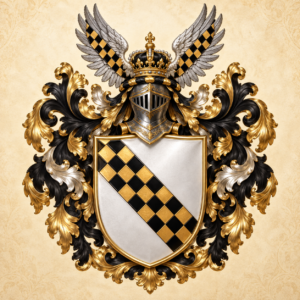
Fürst zu Schedingen
99,90 €
Prince de Visconti: Brilliance and Myth of Lombardy
Milan, Northern Italy – Late Middle Ages to Early Renaissance
In the heart of the fertile Po Valley, the Visconti dynasty of Milan forged one of the most influential metropolises in Europe. The world-famous coat of arms featuring the crowned serpent, the Biscione, still heralds chivalrous determination, diplomatic finesse, and visionary drive. Under their rule, world-renowned cathedrals, formidable castles, and a magnificent court were established. A resonant Italian princely title for charismatic strategists who blend historical depth with innate elegance and bold creativity.

Principe de Visconti
99,90 €
Prince of Salerno: The Legacy of the Normans
Campania, Southern Italy – High Middle Ages (11th–13th Century)
High above the azure Gulf, the Prince resided in the Castello di Arechi, where Norman conquest met Byzantine splendor and Mediterranean culture. Salerno, as the seat of the oldest school of healing in Europe, was a radiant center for intellect, trade, and seafaring. The title exudes the fragrance of blooming lemon groves, sun-kissed stone, and chivalrous determination. Ideal for personalities who wish to combine a sense of southern lifestyle with a sovereign presence, warmth, and a sunny disposition.
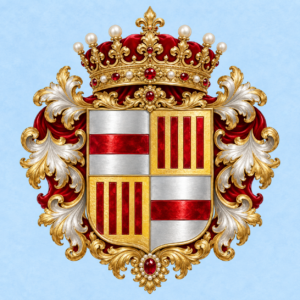
Principe di Salerno
89,90 €
Kōshaku von Echizen: Samurai Dignity and Imperial Finesse
Fukui Prefecture, Japan – Meiji Era (19th Century)
On the snow-laden coast of the Sea of Japan, the ruling Matsudaira clan from the ancient fief of Echizen decisively shaped the fate of the country. In the Meiji nobility system (Kazoku), the Kōshaku stood at the top – supported by the iconic family crest (Kamon). This title unites the incorruptible code of honor of Bushidō with imperial high culture, silk robes, and intricate swordsmithing. Perfect for reflective characters with iron focus, inner peace, and a fascination for East Asian philosophy.
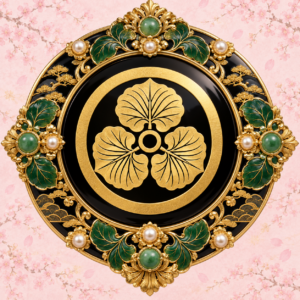
Kōshaku von Echizen
69,90 €
Knjas of Chernigov: Rulers of Kievan Rus
Historical Rus, Eastern Europe – 10th to 13th Century
In the forested heart of Kievan Rus, the principality of Chernigov was regarded as a powerful cradle of East Slavic princely dynasties. Under the golden domes of the Cathedral of the Savior, the Knjas ruled on equal terms with the Grand Princes of Kiev. The double-headed imperial eagle on the coat of arms testifies to iron sovereignty, wide river flows, and ancient heraldic tradition. An archaic, powerful princely title for determined doers who appreciate historical depth, steadfastness, and unwavering cohesion.
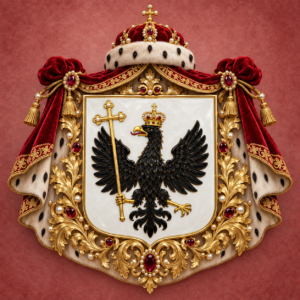
Knjas von Tschernigow
69,90 €
Duke of Sandomir: Pride of the Polish Crown
Little Poland, Vistula Region – 12th to 14th Century
Perched on white limestone cliffs above the Vistula, the Duchy and Principality of Sandomir secured important trade routes of Central Europe. As a significant sub-principality under the Piast rulers, Sandomir unified formidable castellans’ castles, wealthy cloth-making towns, and chivalrous martial arts. The richly adorned coat of arms with stars and stripes reflects the proud noble spirit of the Szlachta. This rank appeals to those who understand the desire for freedom, chivalric virtues, and loyalty as the cornerstones of their actions.
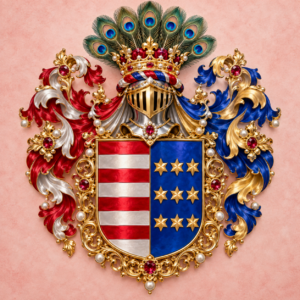
Książę von Sandomir
69,90 €
Emir of Najd: Ruler over Oases and Desert Sands
Arabian Peninsula, Najd Plateau – 18th to 19th Century
In the endless interior of the Arabian desert, the bold Emirs of Najd commanded strategic trade caravans, oasis towns, and noble purebred Arabians. Crossed scimitars and the shade-giving palm in the coat of arms tell of unyielding determination, legendary Bedouin hospitality, and desert winds. The title of Emir reflects the highest leadership authority and familial honor. A masterful choice for unconventional spirits who wish to broaden their horizons and combine foresight with unwavering courage.
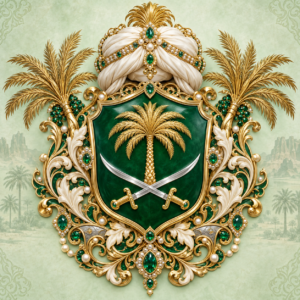
Emir von Nadschd
119,90 €

The princely title marked the pinnacle of secular and spiritual power within the empire – correspondingly ruthless, absurd, and excessive were the disputes among princes over influence, wealth, and eternal salvation.How far a prince would go to make himself indispensable is exemplified by Margrave Albrecht Achilles of Brandenburg, one of the shrewdest electors of the 15th century. He waged endless private feuds against Franconian imperial cities and neighboring princes throughout his life and was so war-hungry that at times he stood against eighteen cities and principalities simultaneously. Albrecht always carried a notebook with him, meticulously recording every detail of enemy castles, troop strengths, and the debts of his rivals. At imperial diets, he was regarded as the most feared puppeteer because he formulated laws and alliances so complicated that in the end, only he himself kept track and was handsomely compensated by all warring parties for rendering a verdict. He mastered the art of instigating conflicts in the first place, only to later be celebrated and generously rewarded as the indispensable savior. Anyone who crossed him quickly found themselves ensnared in a legal thicket from which they could only extricate themselves with hard cash. His contemporaries admiringly yet fearfully dubbed him the German Achilles, as he conducted politics not with morality but with cold accounting.
An even more extreme bloom was exhibited during the notorious Brandenburg-Nuremberg War in the mid-15th century, where princely arrogance clashed with bourgeois wealth with full force. Albrecht Achilles despised the wealthy patricians and merchants of Nuremberg as ordinary moneybags who had no respect for princely blood. To force the proud imperial city to its knees, he ordered the entire surrounding area to be burned, mills destroyed, and wells poisoned. When the Nuremberg mercenaries eventually surprised him in a skirmish and cornered him, the prince faced the heavy shame of a ransom trap. He only saved himself by tearing off his splendid, jewel-encrusted armor piece by piece while galloping away and throwing it behind him. The plan worked: the greedy Nuremberg mercenaries halted to collect the precious spoils, while the naked elector escaped over the hills in nothing but his simple undershirt. The incident spread through the empire like wildfire, ensuring that citizens mocked the involuntary princely fashion show for years to come.
That ecclesiastical princes were no less ruthless is evidenced by the bloody feud over the Archdiocese of Mainz in 1461/62, which went down in history as the Mainz Cathedral Feud. Pope Pius II had summarily deposed the legitimately elected elector Diether von Isenburg and appointed Adolf von Nassau as the new prince-bishop. Diether simply refused to vacate his throne, whereupon the two churchmen did not arm themselves with biblical quotes but with mercenary armies and heavy cannons. Adolf von Nassau stormed Mainz in the dead of a pitch-black October night, burned large parts of the city, plundered the cathedral, and expelled hundreds of respected citizens. Among the unfortunate was none other than Johannes Gutenberg, whose printing workshop went up in flames, leaving him completely destitute on the street. To somewhat mitigate the massive PR damage of the massacre, the victorious bishop promptly appointed Gutenberg as the princely court nobleman and fed the inventor of the printing press with fine court attire, some grain, and a few barrels of free beer.
One of the most bizarre excesses of princely self-representation was orchestrated by Elector Ernst of Saxony along with his brother Albrecht in 1475. After the famous Altenburg Prince’s Robbery – in which a disgruntled knight had attempted to abduct the two as small boys from the princely castle and miserably failed – the brothers left no opportunity to showcase their boundless wealth. At their banquets, they had towering ornate cakes brought in, from which live songbirds and costumed dwarfs would spring forth, while the fountains in the castle courtyard spewed real white and red wine instead of water for days. To prove that the Saxon silver mines were virtually inexhaustible, they had freshly minted silver coins thrown into the common folk with real shovels at festive grounds. The resulting brawls in the mud were gladly accepted by the princely hosts as amusing accompaniment to their pompous lifestyle. Anyone wishing to impress in the 15th century did not think in terms of frugality but flaunted until guests were literally drunk and showered in filth.