Duke & Duchess – The Crown Within Reach
Counts managed provinces, barons secured borders and held the outposts of the realm – yet the duke historically stood on an entirely different level. He was not merely an administrator of foreign property or a loyal official on call, but the sovereign of his own realm, to which the crown was often only nominally superior. Linguistically deeply rooted in the Old High German term for that commander who rode into battle before his own banners in the face of danger, the rank grew over the centuries to become the purest embodiment of territorial self-determination.
A duke created his own world: He possessed high jurisdiction, minted heavy silver bearing his own likeness, levied tolls at rivers and mountain passes, and independently determined matters of war and alliance. This almost limitless autonomy shaped a self-understanding that is still reflected in every breath of this title today. Those who carry such a predicate as a modern aristonym do not claim a pleasing surname for their business cards. It is the conscious celebration of an inner sovereignty that seeks no external confirmation but speaks for itself through calm composure and unmistakable presence.
The German Duke: Tribal Prince, Oak Leaves, and Unshakeable Stability
At the heart of the continent, the title of duke is inextricably woven with the powerful, primordial tribal areas of Bavaria, Saxony, Swabia, and Franconia. Here, the nobility met the elected emperors of the Holy Roman Empire on equal terms; some dukes commanded more soldiers and more fertile land than the crown itself. Vast forests of centuries-old oaks, sturdy castles of red sandstone, and later the masterful Baroque residences with their expansive palace gardens still testify to that era when stability, loyalty to one’s own territory, and deep-rootedness formed the foundation of every rule.
It is a world of quiet, dignified grandeur: the crackling fireplace in the wood-paneled study, heavy, hand-made paper embossed with a deep coat of arms, and a fascination for things that defy the fashions of the time. Here, the masterfully engraved pocket watch, frame-stitched leather goods, hunting in the autumn mist, and ancient tomes in the private library count far more than fleeting glamour. A German duke embodies that unshakeable reliability that calmly weathers storms because the foundation has been solidly built for generations.
This time-honoured rank appeals primarily to individuals who are grounded in life, value authenticity over loud pomp, and wish to crown their own achievements with timeless, Central European dignity.
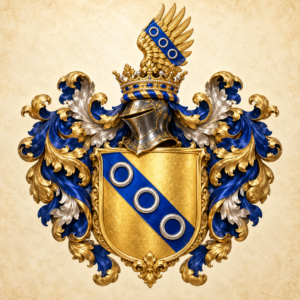
Herzog zu Katharienburg
89,90 €
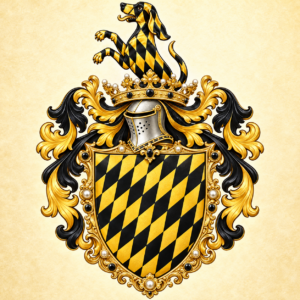
Herzog zu Berwangen
89,90 €
Herzog von Teck
99,90 €
The British Duke: Crest, Savile Row, and the Measure of All Things
Across the English Channel, the duke marks the undisputed pinnacle of the entire aristocratic structure – higher stands only the royal family. A duke does not enter a society to garner glances or seek attention; the room arranges itself upon his arrival. Since King Edward III created the Duchy of Cornwall in the 14th century, this title has been surrounded by an almost legendary radiance that has determined the political, cultural, and social fate of Britain for generations.
His ancestral terrain consists of the monumental country estates of the English counties and the mist-shrouded fortresses of the Scottish Highlands. Here, polished mahogany glimmers in the firelight, while the gazes of gold-framed ancestral portraits fall upon exquisite first editions and silverware. Yet this splendour carries no stiffness: Harris tweed meets comfortable wellington boots on the way to the stables, and the affection for noble thoroughbreds seamlessly combines with the high art of understatement. In the private clubs of London’s St. James’s district and the traditional tailoring houses of Savile Row, the duke moves with a dreamlike elegance – always accompanied by dry humour, perfect etiquette, and a sip of smoky single malt.
Those seeking the purest quintessence of British class, world-renowned style, and that enviable, cool understatement will find their perfect counterpart in the profile of the duke.
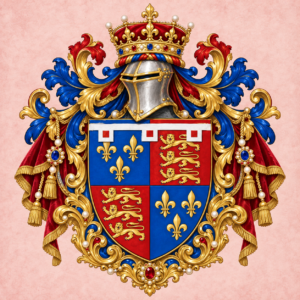
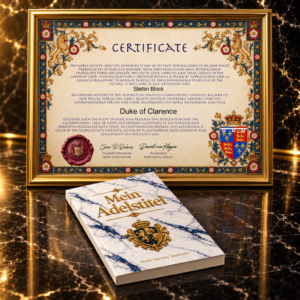
Duke of Clarence
79,90 €
The Cradle of Continental Grandeur: The Duc in France
Nowhere else in Europe did princely power, architectural mastery, and perfected savoir-vivre merge into such an intoxicating unity as at the French court. The French duc was not a mere dignitary of the king but ruled states within a state: Consider the dazzling, almost immeasurable wealth of the Duchy of Burgundy, the martial elegance of the Norman coasts, or the sun-drenched châteaux in the Loire Valley. As secular Pairs de France, the ducs held the royal insignia during the coronation ceremonies in Reims and shaped the taste of an entire continent.
Here, existence is elevated to the highest art form. It is the world of expansive city palaces in Paris’s Faubourg Saint-Germain, private vineyards with ancient vineyards, and long evenings by flickering candlelight. When exquisite Grand Cru wines are served, that incomparable conversation full of wit, spirit, and fine irony unfolds, which is admired worldwide as the French spirit. At the duc’s, heavy wrought-iron castle gates meet a feather-light, natural finesse: Nothing seems forced, everything happens with that dreamlike ease that characterizes the true connoisseur.
A predicate perfectly suited for connoisseurs of haute cuisine, passionate collectors of fine arts, and individualists who wish to not only cope with life but celebrate it with intellectual brilliance and worldly charm.
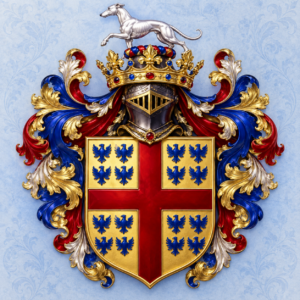
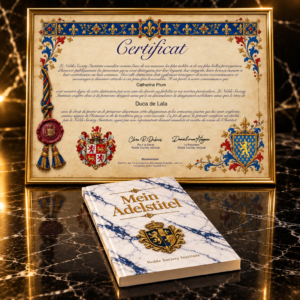
Duc de Montmorency
89,90 €
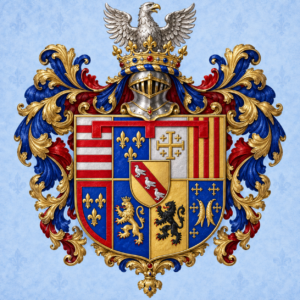
Duc de Guise
79,90 €
Mediterranean Princely Splendor: Duca in Italy and Duque in Spain
Under the warm sun of the south, the duchy transforms into a vibrant feast for all the senses, charged with dramatic history, artistic genius, and proud demeanor. In Italy, the duchi – dynasties such as the Medici in Florence, the Gonzaga in Mantua, or the Visconti and Sforza in Milan – created the radiant epoch of the Renaissance. The Italian duca ruled as a generous patron of the arts, commissioning palaces of white marble and supporting visionaries like da Vinci and Michelangelo. His day begins with a view over cypress-lined hills and silver olive groves, carried by that famous sprezzatura – the innate gift of making even the most exalted elegance appear completely effortless and light.
On the Iberian Peninsula, the Spanish duque combines this brilliance with knightly gravitas and a global presence. Shaped by the Reconquista and the global empire of the Habsburgs, many of them enjoyed the exalted rank of Grande de España. This granted them the legendary privilege of keeping their hats on even in the direct presence of the king – the unmistakable sign of sovereign equality. Surrounded by the aura of Moorish palace architecture, fiery Andalusian thoroughbreds, and an unwavering sense of family honour, the duque carries himself with unmistakable pride.
The ideal choice for passionate characters, art-loving aesthetes, and connoisseurs of the south who wish to enrich their surroundings with warm charisma, proud elegance, and vibrant hospitality.
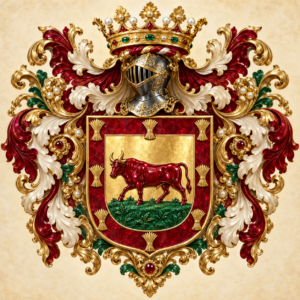
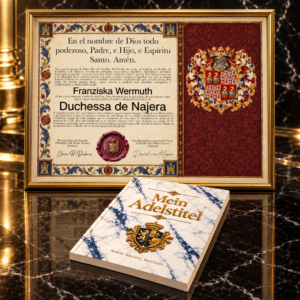
Duque de Gandía
79,90 €
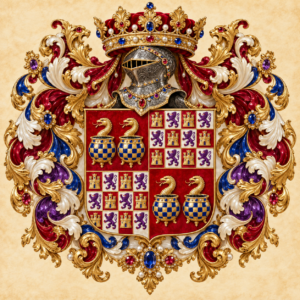
Duque de Nájera
79,90 €
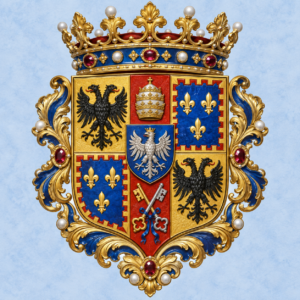
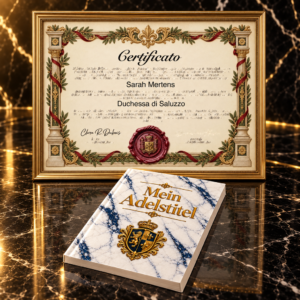
Duca di Ferrara
79,90 €
Duca de Colonna
79,90 €
Exotic Duke Titles: From the Imperial Gong to the Princes of the Orient
True princely stature was historically never confined to the borders of Europe; wherever great civilizations flourished, ranks of comparable elevation and significance emerged. In the Empire of China, the title of Gong (公) represented the highest level of the classical five-tiered nobility and the highest dignity that could be bestowed upon a dignitary outside the imperial house. It was the shining symbol of masterful Confucian scholarship, precious silk robes, intricately carved jade insignia, and that far-sighted statecraft that weathered dynastic crises with stoic wisdom.
In the Arab world, sovereign grand empires commanded brilliant oasis metropolises, important caravan routes, and fertile river oases. Their authority stemmed from legendary generosity, the protection of travelers, noble falcons, and bold strategic foresight under the vast sky. Additionally, there are the historically significant titles of the Hispano-American viceroyalties from Peru to New Spain, where European grandeur merged with the untamed pioneering spirit and boundless horizons of a New World.
For cosmopolitans, globetrotters, and intellectual explorers, such a title offers the perfect stage to escape ordinary life and underscore their personality with an international profile, wanderlust, and a palpable free spirit.

The dukes stood directly below the king in the medieval nobility and often ruled vast territories like their own monarchs. Accordingly, the claims to power, vanities, and bizarre escalations were monumental.
The most notorious power struggle of the High Middle Ages revolved around Henry the Lion, Duke of Saxony and Bavaria. He was so powerful and immensely wealthy that he treated Emperor Frederick Barbarossa at times like a bothersome petitioner. When Barbarossa urgently needed armoured Saxon cavalry in Chiavenna before a decisive battle against the rebellious northern Italian cities in 1176, the proud duke flatly refused to provide his allegiance. The emperor’s desperation drove him to publicly kneel before his most powerful vassal to plead for support. Henry did not help the monarch up but coolly assessed him and rode away with his retinue. The emperor lost the battle resoundingly, yet he never forgot the profound humiliation: He patiently awaited his chance, initiated a merciless imperial court trial, imposed the imperial ban, and forever shattered the Saxon grand duchy into tiny principalities. Henry ultimately ended up as a politically powerless exile, bitterly learning that even the proudest lion should never leave an aggrieved emperor standing in the dust.
The loyalty and presence of mind of a duchess could even overcome the cruelty of a months-long siege, as evidenced by the famous myth of the Loyal Women of Weinsberg from 1140. King Conrad III besieged the fortress of the rebellious Duke Welf VI with all severity, cutting off all supplies to the castle. After a tough, desperate resistance, the besieged ran out of food, and the castle had to surrender unconditionally. The enraged king ordered all the men inside to be executed as traitors but graciously allowed the noble women to leave the fortress unharmed, taking with them whatever they could carry on their shoulders. Conrad expected to see bulging jewelry boxes and bags of gold, but when the castle gates opened, the besiegers were left breathless: The women carried out not jewels or silver but heaved their husbands – foremost among them the duke and his knights – panting on their backs down the mountain. The royal advisors immediately demanded access due to breach of word, but the king was so amused and impressed by this clever coup that he kept his word and allowed the entire garrison to leave unscathed.
One of the most flamboyant and unrestrained figures of the Middle Ages was Duke William IX of Aquitaine, who entered history as the first named troubadour in Europe. As one of the wealthiest dukes of his time, he owned far more land than the French king himself, yet he led a lifestyle that regularly drove the clergy to the brink of nervous breakdown. He composed cheeky, unabashedly risqué verses about carnal pleasures, mocked the refined court society, and founded a pseudo-nunnery purely out of mockery of the bishops, which he filled exclusively with his mistresses. When the Bishop of Poitiers attempted to excommunicate him during a solemn mass before the assembled congregation, William drew his sword in the middle of the church, angrily grabbed the church leader by the collar, and threatened to slit his throat immediately if he uttered the excommunication formula. The cleric was not intimidated and stoically completed the curse, whereupon the duke unexpectedly sheathed his sword, laughed heartily, and dryly remarked that he despised the cleric too much to grant him a quick martyr’s death that would allow him immediate entry into heaven.
That excessive ducal hubris could end in unprecedented humiliation on the battlefield was demonstrated by Charles the Bold, the last great duke of Burgundy. In the 15th century, he ruled the richest, most flamboyant court in all of Europe and was obsessively dreaming of transforming his territory into an independent, powerful kingdom. He rode into battle with golden opulent tents, jewel-encrusted armour, court jesters, and a gigantic entourage against seemingly simple Swiss peasant soldiers. However, in the battles of Grandson and Murten in 1476, his arrogance suffered a devastating blow: The Swiss pike formations utterly crushed Charles’s proud knightly armies within hours and seized the legendary Burgundian treasury along with priceless diamonds and artworks. In 1477, the unrepentant duke met a pitiful end before the gates of Nancy: He fell from his horse in the winter chaos, was slain in the mud, and was found two days after the battle half-naked, gnawed by hungry wolves, and frozen in the ice of a pond. His servants could only identify the once most powerful monarch of the era by old scars and his remarkably long fingernails – a ghastly reminder of how far a prince could fall from the golden throne into the muck.
For the most idiosyncratic coronation ritual of the Middle Ages, the Carinthian rulers provided the legendary duke’s chair on Zollfeld. While other dukes of Europe were anointed by archbishops in incense-laden cathedrals and crowned with gold, the new Carinthian prince had to publicly submit to a simple peasant. The duke stripped off his splendid garments, donned a coarse grey peasant’s robe, put on a simple cap, and approached the Prince’s Stone on foot. There sat a free peasant who sternly interrogated the throne candidate in Slovenian and demanded that he solemnly swear to uphold the rights of the common people, to be a just judge, and to protect the land from attackers. As a symbolic test of humility, the peasant delivered a hearty slap to the duke’s cheek in front of the assembled populace, receiving as compensation a noble horse along with a handful of silver coins before reluctantly vacating the place on the stone. Only after this hearty lesson was the duke allowed to swing his sword in all four directions – an unmistakable reminder that feudal rule without the obedience of the common people was simply built on sand.